
Choosing the right fence is critical for protecting your land, livestock, and garden. The ideal fence prevents animals from escaping, keeps predators out, and enhances security. Here's a quick rundown of 10 top fencing options, each with its strengths, costs, and uses:
- Woven Wire Fence: Durable and flexible, ideal for livestock and predator control. Costs $1.50–$6.00/ft installed.
- Barbed Wire Fence: Affordable and effective for large livestock but less suitable for small animals. Costs $2.50–$6.50/ft installed.
- Welded Wire Fence: Strong and secure with minimal maintenance. Costs $4–$10/ft installed.
- High-Tensile Electric Fence: Delivers a shock to deter animals and intruders. Costs $2–$5/ft installed.
- Hinge-Joint Field Fence: Flexible and strong for livestock containment. Costs $1.50–$5.90/ft installed.
- Fixed-Knot Fence: Long-lasting and highly secure for livestock. Costs $7–$12/ft installed.
- Electrified Poly Wire or Tape: Temporary and low-cost, great for quick setups. Costs $0.50–$2.00/ft installed.
- Vinyl Fence: Low-maintenance and long-lasting, ideal for privacy and livestock. Costs $25–$60/ft installed.
- Treated Wood Fence: Classic and customizable but requires regular upkeep. Costs $25–$45/ft installed.
- Recycled Plastic Fence Posts: Durable and eco-friendly, with minimal maintenance. Costs $22–$40/ft installed.
Quick Comparison
| Fence Type | Durability (Years) | Best For | Cost (Installed) | Maintenance |
|---|---|---|---|---|
| Woven Wire | 15–20 | Livestock, predators | $1.50–$6.00/ft | Low |
| Barbed Wire | 15–25 | Cattle, large livestock | $2.50–$6.50/ft | Moderate |
| Welded Wire | 8–20 | Gardens, security | $4–$10/ft | Low |
| High-Tensile Electric | 15–20 | Livestock, intruders | $2–$5/ft | Moderate |
| Hinge-Joint Field | 15–20 | Livestock | $1.50–$5.90/ft | Low |
| Fixed-Knot | 20–30 | Livestock, predators | $7–$12/ft | Low |
| Electrified Poly Wire | 3–5 | Temporary setups | $0.50–$2.00/ft | High |
| Vinyl | 20–30 | Privacy, livestock | $25–$60/ft | Very Low |
| Treated Wood | 15–25 | Livestock, privacy | $25–$45/ft | High |
| Recycled Plastic Posts | 20–30 | Eco-friendly, livestock | $22–$40/ft | Very Low |
Each option serves different needs, so assess your property, budget, and security priorities before deciding.
@figure 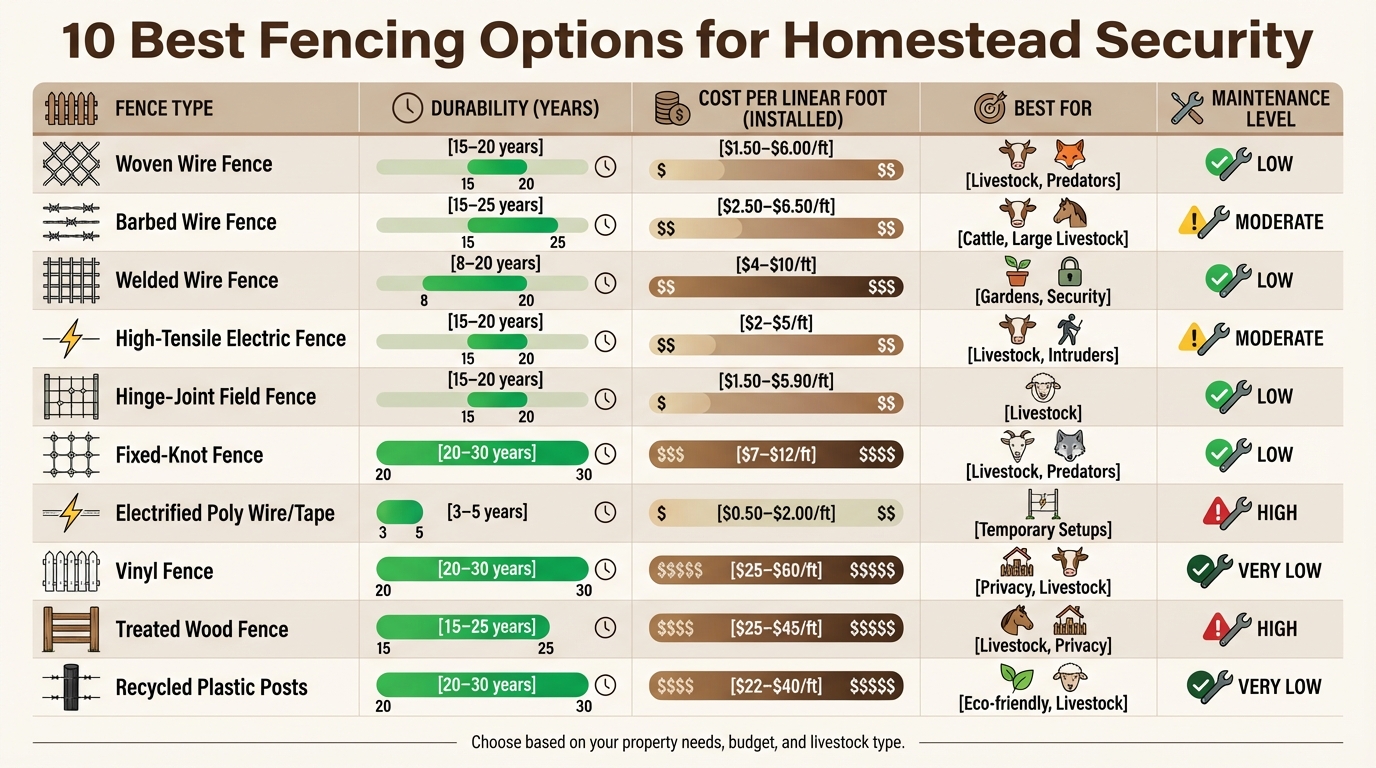 {Homestead Fencing Options Comparison: Cost, Durability & Best Uses}
Best Fencing Options for Your Homestead or Farm
1. Woven Wire Fence
Woven wire fencing, often called page or field fence, features vertical and horizontal wires knotted at every intersection. This design allows the fence to flex under pressure, such as when livestock lean against it or the ground shifts. Unlike welded wire, which can break under heavy strain, woven wire holds strong. Steve Maxwell, a seasoned builder, highlights its reliability:
"Woven wire is the kind of permanent, reliable fencing that is the industry standard for containing cattle, sheep, goats and horses."
Durability and Lifespan
The lifespan of woven wire fencing largely depends on its coating. Class I galvanized wire typically lasts 8–10 years, while Class III can endure 15–20 years. Aluminum-coated wire offers even greater resistance to rust, lasting 3–5 times longer than Class I. Pressure-treated posts provide a solid foundation, lasting 25–30 years. When installed correctly, a woven wire fence can serve reliably for about 20 years. This durability ensures consistent protection for your property.
Effectiveness for Livestock Containment and Intruder Deterrence
Woven wire fencing is strong enough to contain even the largest livestock. For example, heavy-duty low-gauge wire can withstand the force of a 2,000-pound bull. Smaller mesh sizes are ideal for containing goats, preventing them from sticking their heads through or climbing, while larger openings work well for cattle. The high visibility of woven wire also acts as a deterrent to intruders, as it eliminates hiding spots and keeps surveillance cameras unobstructed. Adding a single strand of barbed wire along the top discourages animals from wearing down the fence and makes it harder for people to climb over. This combination of strength and visibility makes woven wire a dependable choice.
Ease of Installation and Maintenance
Installing woven wire fencing requires time and effort. Covering a quarter-mile (1,320 feet) takes about 40 hours. At least two people are needed to handle the heavy rolls, and a mechanical fence stretcher is essential for pulling the wire taut between corner posts. Posts should be spaced every 8–12 feet. Maintenance is relatively simple - inspect the fence annually for rust or damage and use mechanical tighteners to retension the wire every 2–3 years. Clearing vegetation within 1–2 feet of the fence helps prevent rust and extends its lifespan.
Cost (Material and Labor)
The cost of woven wire fencing varies based on materials and labor. Professional installation typically ranges from $1.50 to $6.00 per linear foot, depending on the wire gauge and mesh size. For example, a quarter-mile fence with one barbed wire strand costs about $1,500, including materials and labor. A 100-foot roll of 2-by-4-inch mesh (5 feet high) costs between $180 and $190. Wood posts range from $20 to $50 each, while metal posts cost $25 to $60. Fencing an acre for livestock would require a budget of approximately $1,700.
2. Barbed Wire Fence
Barbed wire is a budget-friendly fencing choice, costing about 30%–50% less than chain-link or wood. Its sharp barbs serve as both a physical barrier and a psychological warning, sending a clear "keep out" message. A standard roll, which spans 1,320 feet (a quarter mile), is priced between $60 and $220, depending on the barb count and the type of protective coating. But its appeal isn't just about cost - its durability and adaptability to different conditions also make it a solid option.
Durability and Lifespan
A properly maintained barbed wire fence can last 15–25 years, and with premium materials, it may even stretch to 50 years. Longevity hinges on factors like wire gauge, coating quality, and the local environment. For example, a Class III galvanized coating provides excellent rust resistance, enduring 13 to 30 years even in humid or coastal areas. Modern galvanized wires are built to withstand extreme weather - whether it's heavy snow, strong winds, or intense sun - without warping or degrading. As Laura Firszt of Networx puts it:
"Good quality barb wire fencing will last as long as 25 years, which helps to justify its relatively high price tag and the fact that it is one of the most difficult fences to install".
Effectiveness for Livestock Containment and Intruder Deterrence
Barbed wire's design makes it effective for keeping large livestock, like cattle, contained. However, it’s not ideal for horses due to the risk of injury, and it may not work well for smaller animals like sheep, goats, or poultry. On the security side, the sharp barbs act as a deterrent. While a determined intruder with the right tools could breach it quickly, the combination of physical and psychological barriers makes it a reliable first line of defense for rural properties.
Ease of Installation and Maintenance
Barbed wire's affordability is paired with straightforward installation, though it does require specialized tools like fence stretchers and heavy-duty gloves for safety. Maintenance is relatively simple, with semi-annual checks for sagging, rust, or broken strands. Tension adjustments are usually needed every two to three years. Installing the wire on alternating sides of the posts can help limit damage to about 20 feet if the fence is struck. Safety gear - thick leather gloves, long sleeves, and eye protection - is a must during installation to avoid injuries.
Cost (Material and Labor)
Material costs range from $0.05 to $0.15 per linear foot, while installation costs, including labor, can range from $2.50 to $6.50 per linear foot. Professional contractors typically charge between $40 and $110 per hour. For fencing an acre, you’re looking at a budget of $835 to $7,100, depending on factors like the number of strands and the quality of the posts used. Opting for DIY installation can significantly cut costs, though it requires time and effort. Keep in mind, many residential areas restrict the use of barbed wire due to safety and appearance concerns.
3. Welded Wire Fence
Welded wire fencing stands out for its strong structure, with vertical and horizontal wires fused at every crossing. This design ensures the fence remains intact even if a wire is cut, providing better security than chain-link or woven wire options. The tight mesh, with small openings that are hard to climb, makes it ideal for high-security purposes like protecting homesteads.
Durability and Lifespan
The lifespan of welded wire fencing depends heavily on its coating. A Class I galvanized coating typically lasts 8–10 years before rust appears, while a Class III galvanized finish can extend that to 15–20 years. For even longer-lasting protection, aluminum-coated fencing offers three to five times more resistance to corrosion, lasting anywhere from 45 to 100 years. Using thicker gauges, like nine-gauge wire, adds extra strength and security.
Effectiveness for Livestock Containment and Intruder Deterrence
This type of fencing is highly effective for keeping livestock contained and protecting gardens from predators such as coyotes or foxes. It works well for animals of all sizes - from poultry and dogs to larger livestock - when heavier gauges are used. The open mesh design allows clear visibility to monitor for predators or intruders, while the tight grid reduces climbing risks. For larger animals like bulls, reinforcing the corners with welded-steel pipes and T-posts can prevent the fence from bending or shifting.
Ease of Installation and Maintenance
Installing welded wire fencing can be a moderate DIY project. Start by setting the posts - either wood or steel - and attach horizontal rails for added stability. Then, secure the mesh while keeping it taut. Wooden posts should be set in concrete with gravel drainage to extend their lifespan, as pressure-treated posts can last 25–30 years. Compared to woven mesh, the lighter weight of welded wire makes it easier to handle. Plus, since the fence doesn’t unravel when cut, securing it is straightforward. Maintenance is minimal thanks to the rigid, fused joints.
Cost (Material and Labor)
The cost of welded wire fencing ranges from $4 to $10 per linear foot, which includes materials and labor. For added safety, vinyl-coated options are available, costing between $12 and $39 per linear foot. Although it’s more expensive than barbed wire (which costs around $0.03–$0.08 per linear foot), welded wire fencing offers a safer and more secure solution for homestead needs.
4. High-Tensile Electric Fence
High-tensile electric fencing is a smart solution that acts as a psychological barrier for livestock. It delivers a quick, harmless shock that trains animals to stay within boundaries while also keeping intruders out. Built with 12.5-gauge high-tensile wire, this fencing can handle up to 1,650 pounds of pressure and bounces back to shape after enduring 1,350 pounds of force.
Durability and Lifespan
The durability of high-tensile wire is impressive. Thanks to a Class 3 zinc coating, it resists rust for at least 50 years. With regular upkeep, the entire fencing system typically lasts 15–20 years. UV-resistant coatings shield it from weather damage, though extreme conditions like ice can sometimes cause short circuits. Lightning strikes can also harm the energizers if grounding isn’t properly set up. Seasonal adjustments are key - tighten the fence during the summer to account for heat expansion and loosen it slightly in the winter to avoid snapping.
Effectiveness for Livestock Containment and Intruder Deterrence
Once animals experience the brief shock, they quickly learn to avoid the fence, making it about 90% effective in keeping them contained. The shock discourages behaviors like leaning or rubbing against the wires. For added security, modern systems can detect tampering and connect to monitoring platforms, alerting property owners to breaches. This combination of containment and security simplifies livestock management and improves property protection.
Ease of Installation and Maintenance
Setting up high-tensile electric fencing is much faster compared to traditional options. Posts can be spaced up to 50 feet apart, a significant difference from the 8–10 feet required for barbed wire. Placing the energizer at the center of the fence line reduces the distance the electrical charge needs to travel, boosting efficiency. A 1,320-foot fence can often be installed in just 2–4 hours, compared to the 30–40 hours typically needed for barbed wire. Maintenance involves adjusting tension with the seasons, clearing vegetation near the fence, and placing warning signs every 50–100 feet.
Cost (Material and Labor)
High-tensile electric fencing offers a cost-effective way to secure your property. For a standard-sized area, initial costs range from $500 to $1,500. Key components include energizers priced at $100–$300 (or $300–$500 for solar-powered models), wire costing $50–$150, and posts priced between $100 and $400. Professional installation typically costs $2–$5 per linear foot, but opting for DIY can save $300–$600 in labor. Operating costs are minimal, as energizers use only 5–10 watts of power, costing less than $5–$10 per month. Overall, this fencing system can cut material and labor expenses by 40–60% compared to traditional fencing methods.
5. Hinge-Joint Field Fence
Hinge-joint field fencing uses short vertical wires wrapped around horizontal strands to create flexible knots. The horizontal wires are designed with tension-producing crimps that allow the fence to expand or contract with temperature changes, while also absorbing animal impact without sagging. This design offers a balance between flexibility and strength, making it a reliable option for containing livestock.
Durability and Lifespan
The lifespan of hinge-joint fencing largely depends on the wire coating. Class I galvanized wire typically begins to rust after 8 to 10 years, while Class III galvanized wire can last anywhere from 15 to 20 years. In areas with high humidity or near the coast, aluminum-coated wire can resist corrosion three to five times longer than galvanized alternatives. Wire thickness also plays a role - while 12.5-gauge wire is standard, thicker 9-gauge wire provides much better resistance to animal impact. Proper post spacing is essential to avoid premature wear or failure.
Effectiveness for Livestock Containment and Intruder Deterrence
Hinge-joint fencing surpasses barbed wire in effectiveness because its woven structure prevents animals from squeezing through. Medium-tensile versions are especially durable, withstanding 1.63 times more force than standard field fence before stretching or breaking. Many hinge-joint fences feature graduated spacing, with smaller mesh openings at the bottom to keep out smaller predators like coyotes, and larger openings at the top to contain bigger livestock. For added security, barbed wire can be installed on top to deter intruders. While the knot design is effective for moderate pressure, it may not be ideal for areas with high-density livestock that frequently push against the fence.
Ease of Installation and Maintenance
Controlled tension is key when installing hinge-joint fencing. A manual fence stretcher or come-along is recommended to achieve the right tension. Charles Sanders emphasizes:
"Woven wire is manufactured with tension-producing crimps... If you overstretch your fence wire as you are installing it, these crimps will be stretched beyond their limits and you will end up with a sagging fence".
For permanent installations, use pressure-treated wood posts or steel T-posts spaced 6 feet apart, with corner posts set at least 3.5 feet deep. If sagging occurs over time, fencing pliers can be used to create "Z" shaped bends in the horizontal wires to restore tension. This straightforward installation process helps keep costs manageable.
Cost (Material and Labor)
Material costs for hinge-joint fencing typically range from $0.80 to $1.10 per linear foot. A 330-foot roll of wire is priced between $269.99 and $299.99. Steel T-posts cost between $25 and $60 each, while wooden corner posts range from $20 to $50. Professional installation costs vary between $1.50 and $5.90 per linear foot, with labor rates averaging $40–$60 per hour. For a 200-foot fence, total costs - including materials and labor - fall between $300 and $1,600. This makes hinge-joint fencing far more economical compared to chain link fencing, which can cost $2,000 to $5,000 for the same length.
6. Fixed-Knot Fence
Fixed-knot fencing takes woven wire fencing to the next level by locking the wires at every intersection. This design prevents the wires from sliding or "zipping" under pressure, a common issue with less durable fencing. The high-tensile wire used in fixed-knot fencing resists deformation, even when livestock lean or push against it. Unlike hinge-joint fences, which can lose their shape under heavy pressure, fixed-knot fences hold up well against significant animal impact. This makes them a strong and long-lasting choice for livestock enclosures.
Durability and Lifespan
Fixed-knot fencing builds upon the strength of woven and hinge-joint fences, offering an extended lifespan. When installed correctly, these fences can last up to 30 years - nearly double the life of traditional barbed wire. Class III galvanized coatings protect against rust for 15 to 20 years, while aluminum-coated versions last three to five times longer, especially in humid or coastal areas. To ensure maximum durability, use corner and brace posts at least 8 inches in diameter and set them in concrete. According to Joseph M. Zulovich from the Department of Agricultural Engineering, a wooden post with a 5-inch diameter is four times stronger than one with a 3-inch diameter.
Effectiveness for Livestock Containment and Intruder Deterrence
Fixed-knot fencing is particularly effective for containing agile animals like goats and sheep, which can often escape through other types of fencing. The vertical stays prevent sagging when livestock lean on the structure, while the tight mesh keeps smaller predators from slipping through. For added protection, bury the mesh 8–12 inches into the ground and extend it outward by 8 inches at the base to deter animals like foxes and badgers. Adding a strand of barbed wire along the top discourages climbing, while another strand along the bottom prevents predators from squeezing underneath. Standard fixed-knot fences have vertical stays spaced 12 inches apart, but premium options with 6-inch spacing offer even tighter containment.
Ease of Installation and Maintenance
Installing fixed-knot fencing requires some expertise. High-tensile wire needs to be carefully tensioned using specialized tools, so professional installation is often recommended. Avoid using living trees as posts, as the wire can become embedded over time. It's also important not to overstretch the crimps during installation, as this can lead to sagging later on. Once properly installed, fixed-knot fences are low-maintenance, needing only biannual tension checks and routine clearing of debris.
Cost (Material and Labor)
The cost of fixed-knot fencing reflects its durability and effectiveness. Materials average $5.42 per linear foot, with total installation costs around $35,118 per mile. Annual maintenance costs are approximately $1,163.55 per mile. Labor rates range from $35 to $70 per hour or $7 to $12 per linear foot. Installing gates adds $200–$600 each, plus permit fees of $20–$60. Repairs typically cost $20–$30 per square foot. While the upfront investment is higher, the minimal maintenance and long lifespan - up to 30 years - make fixed-knot fencing a cost-effective choice for long-term use.
7. Electrified Poly Wire or Tape
If you're looking for a temporary and affordable fencing solution, electrified poly wire or tape can be a great choice to pair with more permanent options. These materials are made from UV-stabilized polymer fibers woven with 3–9 strands of stainless steel or aluminum. Unlike barbed or fixed-knot wire, these fences don't rely on physical barriers - they act as psychological deterrents, delivering a sharp, memorable shock to keep animals and intruders at bay.
Durability and Lifespan
Electrified poly wire and tape typically last 3 to 5 years when exposed to the elements. Over time, UV light can weaken the fibers, causing them to become brittle and break. Polytape, while highly visible, tends to "flutter" in the wind, which makes it wear out faster than polywire. In areas with strong winds or icy conditions, poly braid or rope is often a better choice due to its durability. Stainless steel filaments in the wire resist rust and perform well in extreme temperatures, while aluminum, though lightweight, is more prone to corrosion and brittleness. To extend the lifespan of these materials, maintain proper tension - around 150–200 lbs - with ratchet-style tensioners.
Effectiveness for Livestock Containment and Intruder Deterrence
Polytape is particularly effective for livestock containment because of its visibility and shock. Its wide, ribbon-like design makes it easy for animals to spot, reducing the likelihood of accidental collisions. Compared to barbed wire, poly products are much cheaper, costing around $0.15–$0.20 per foot versus $1.20–$1.50 per foot for barbed wire. Plus, installation is quicker - a 1,320-foot fence can be set up in just 2 to 4 hours, compared to 30 to 40 hours for barbed wire.
For maximum visibility, white polywire or tape works best against green or brown backdrops, while black or high-contrast colors are better suited for snowy areas. The system delivers a quick 4,000V–5,000V pulse, which effectively deters wildlife and trespassers without causing lasting harm. To reduce liability, always post clear warning signs along the fence. With its lower cost and ease of installation, this system is a practical DIY project for many.
Ease of Installation and Maintenance
Installing electrified poly wire or tape is straightforward and can save 40–60% on labor costs. The material is lightweight - a 3,366-foot spool weighs just 5.7 to 7 pounds - making it easy to handle. Use polytape connectors and ratchet tensioners to avoid knots, which can disrupt energy flow. Proper grounding is crucial for the system to work effectively; you'll need at least three grounding rods driven 6 feet deep, as grounding issues are the most common cause of system failures. Regular maintenance is also important - inspect the fence weekly to clear any vegetation touching the line, as plants can cause voltage drops. Operating costs are minimal, with a 4.5-watt energizer costing less than $10 per year to run.
Cost (Material and Labor)
Electrified poly wire is an economical option for temporary fencing. For example, a 656-foot roll of Zareba Yellow 6-Conductor Polywire costs $36.99, while a 1,320-foot roll is priced at $64.99. Installed costs range from $0.50 to $2.00 per linear foot for temporary systems. Key components include energizers ($100 to $800), step-in posts (around $2.50 each), and optional solar chargers (ranging from $100 to $300+). A complete 1/4-mile setup costs roughly $240. Professional installation is also an option, with rates ranging from $35 to $130 per hour. However, keep in mind that poly materials last only 3 to 5 years, compared to the 20 to 30+ years you’d get from high-tensile steel or woven wire.
8. Vinyl Fence
Vinyl fencing is a modern, low-maintenance solution for homesteads needing privacy and reliable livestock containment. Unlike wood or metal, vinyl is resistant to rot, moisture, pests, rust, and corrosion. It's also non-toxic and doesn't splinter, making it a safer choice for animals like horses and cattle, as well as household pets.
Durability and Lifespan
Vinyl owes its durability to special additives and modifiers included during manufacturing, which enhance its resistance to impacts and UV damage. Professional-grade vinyl uses virgin PVC with UV inhibitors to prevent yellowing and deterioration from sunlight. On the other hand, consumer-grade vinyl from big-box retailers often uses recycled materials, making it thinner and less durable, with a lifespan of about 10 years compared to the 20–30 years expected from professional-grade options. High-quality installations can even last up to 40 years. For added strength, look for panels with interior ribbing and reinforced bottom rails with galvanized steel, especially if your property faces high winds or houses large animals. This makes vinyl a solid choice for homesteaders dealing with unpredictable weather.
Effectiveness for Livestock Containment and Intruder Deterrence
Vinyl's versatility extends to livestock containment, with "post and rail" or "ranch rail" designs offering durability without sharp fasteners that could harm animals. It is about five times stronger and more flexible than wood, making it effective for keeping horses and cattle safely enclosed. For security, solid privacy panels (6 to 8 feet tall) provide a strong visual and physical barrier, blocking sightlines and deterring intruders. While vinyl isn't as impact-resistant as metal or masonry, it still offers a dependable level of protection.
Ease of Installation and Maintenance
One of vinyl's biggest advantages is its low maintenance - cleaning it is as simple as using soap and water. However, installation requires precision, as even slight misalignments can be noticeable on its uniform panels. For taller privacy fences, professional installation is recommended, as it involves specialized tools like post-hole diggers and concrete-setting equipment. A DIY approach can save between $5 and $10 per linear foot, but careful handling is needed to avoid wasting costly pre-cut panels. In windy regions, securing post caps with PVC fence glue can help prevent them from loosening due to temperature changes.
Cost (Material and Labor)
While vinyl fencing comes with a higher upfront cost compared to wood, it offers long-term savings by eliminating the need for regular staining, sealing, or painting. Materials typically range from $25 to $40 per linear foot, with full installations costing between $25 and $60 per linear foot. The national average for a complete installation is about $4,045. Gates can add anywhere from $300 to $1,500 for a single unit, or up to $2,500 for decorative or double gates. For more budget-friendly options, three-rail (split-rail) vinyl fencing costs $11 to $18 per linear foot and works well for basic livestock enclosures. However, vinyl is best suited for moderate climates, as extreme cold can make it brittle and prone to cracking, while extreme heat may cause expansion and warping.
9. Treated Wood Fence
Treated wood fences strike a great balance between natural charm and practicality, making them a popular choice for homestead security. These fences are crafted from pressure-treated lumber, which is infused with chemicals like alkaline copper quaternary (ACQ) or copper azole (CA) to protect against rot, fungi, and insect damage. Modern treatments use EPA-approved chemicals, ensuring they’re safe for families and pets. Approximately 80% of wood fence panels are made from either Western red cedar or pressure-treated southern yellow pine.
Durability and Lifespan
A treated wood fence can last anywhere from 15 to 25 years, depending on the type of wood, the depth of treatment, and how well it’s maintained. For example, pressure-treated pine typically lasts 12 to 15 years, cedar holds up for 15 to 25 years, and redwood can endure for 20 to 30 years. However, fence posts tend to fail first, especially at the point where they meet the soil. To extend the life of your fence, use ground-contact-rated posts set 2–3 feet deep in a gravel base, maintain a 2-inch gap between the wood and the soil, and secure everything with hot-dip galvanized or stainless steel fasteners.
Effectiveness for Livestock Containment and Intruder Deterrence
The design of the fence plays a major role in its effectiveness. Privacy styles like board-on-board or tongue-and-groove create a solid barrier, making them ideal for containing pets and deterring intruders. On the other hand, post-and-rail or split-rail designs are better suited for large livestock. For added security, consider taller fences (6 to 8 feet) with minimal gaps between the boards to create a stronger visual and physical deterrent. Plus, installing a quality fence can boost your property’s value by up to 10%.
Ease of Installation and Maintenance
Treated wood fences are straightforward to install and easy to customize, making them suitable for DIY enthusiasts. However, more intricate designs like shadowbox or louvered fences may require professional installation to ensure stability. The trade-off is that wood fencing demands more upkeep than materials like vinyl or metal. To keep it in good shape, apply a weatherproof sealant every 2 to 3 years, regularly clean the fence, and inspect for issues like loose boards, warping, or fungal growth. Trimming plants or shrubs around the fence can also improve airflow and prevent moisture from getting trapped.
Cost (Material and Labor)
While treated wood fences are moderately priced upfront, their ongoing maintenance makes them more expensive in the long run compared to vinyl or metal options. Professional installation costs range from $25 to $45 per linear foot, with most homeowners spending between $1,920 and $4,841 for a complete fence. Pressure-treated pine is the most budget-friendly option, costing about half as much as cedar and one-third as much as redwood. Labor typically accounts for around 50% of the total project cost. To save money, consider scheduling installation during fall or winter when labor costs can drop by 10% to 20%. A cost-effective hybrid approach involves using pressure-treated pine for the posts (to enhance ground-contact durability) and cedar for the pickets (for better weather resistance).
10. Recycled Plastic Fence Posts
Recycled plastic fence posts are becoming a go-to option for homesteaders looking for a tough, low-maintenance alternative to traditional wood. Made from materials like high-density polyethylene (HDPE) or wood-plastic composites, these posts not only stand up to the elements but also help repurpose waste, keeping billions of plastic containers out of landfills. Thanks to modern manufacturing techniques like co-extrusion and automated sorting, these posts now offer improved durability and aesthetics, with UV-stable finishes available in colors like charcoal, oak, and mahogany.
Durability and Lifespan
These posts are built to last. They resist rot, insects, and moisture, staying structurally sound for 20 to 30 years - or even longer. In fact, they often outlive untreated wood by three to five times, especially in areas prone to termites or heavy rainfall. Many manufacturers back their products with 20- to 25-year warranties. Plus, unlike wood, these posts won’t warp, crack, or twist, even under extreme weather conditions like high humidity, heavy rain, or temperature swings.
Effectiveness for Livestock Containment and Intruder Deterrence
Recycled plastic fence posts provide a sturdy and reliable barrier. They’re tough to cut or damage with common tools, making them effective for securing perimeters. Their non-conductive properties also make them ideal for electric fencing, though it’s still smart to use rated insulators to avoid wire abrasion. For areas requiring extra strength, such as gates or high-tension wire setups, reinforcing the posts with galvanized steel or pressure-treated wood inserts can enhance their resistance to bending. Setting posts at least one-third of their length below ground ensures stability and prevents issues like frost heaving, making them a solid choice for various fencing systems.
Ease of Installation and Maintenance
Installing these posts is similar to working with wood. Pre-drilling fastener holes minimizes the risk of bulging or splitting, and using corrosion-resistant screws or brackets - like those made from galvanized or stainless steel - ensures durability. Once installed, maintenance is a breeze. A quick wash with soap and water is all that’s needed, eliminating the hassle of staining, painting, or sealing.
Cost (Material and Labor)
Recycled plastic posts come with a higher upfront cost, averaging $22–$40 per linear foot installed, which means a 200-foot fence might cost around $5,600. While this is roughly double the price of pressure-treated lumber, the long-term savings are significant. You can skip recurring costs like staining or painting, which typically run $3.50 to $13 per linear foot every few years. Labor makes up about 50% of the total project cost, but scheduling the work during the off-season - late fall or winter - can save you 10% to 20%.
Conclusion
From woven wire to high-tensile electric systems, every fencing option brings specific advantages when combined with the right security measures. The key is to choose a fence that aligns with your homestead's needs and the type of livestock you’re managing. For cattle, barbed wire or fixed-knot fences offer the strength needed for large animals. Sheep, goats, or poultry are better suited for woven or welded wire, which provides tight mesh to block predators while keeping animals contained. Horse owners should consider mesh wire at least 4'6" tall for safety, and for deer control, high-tensile electric wire at nose height or a physical barrier of 6–8 feet works best.
The effectiveness of your fence also hinges on a secure gate. Install heavy-duty locks, keypad systems, or automated gates to prevent unauthorized access. For added deterrence, consider anti-climb spikes, rotating rollers, or a top strand of barbed wire.
Layered security offers even greater protection. Research shows that combining fencing with motion-activated lights can reduce security incidents by 34%. Natural barriers, like thorny hedgerows of hawthorn or barberry, create self-repairing obstacles that are tough to penetrate. Additionally, animal guardians such as Great Pyrenees dogs, guard geese, or donkeys provide mobile patrol and alert functions.
AgentXSurvival (https://agentxsurvival.com) provides tools to enhance perimeter defense, including smart sensors, surveillance systems, self-defense training, and off-grid power solutions like the Lost Generator. Advanced options like infrared beams, tripwire alarms, and drones equipped with thermal cameras can form an "invisible fence", alerting you to breaches before they reach your property.
Before starting any fencing project, check your local regulations. Laws around barbed wire, electric fences, and "open range" requirements differ by state and county. Plan your budget accordingly. For example, fencing a 1- to 5-acre homestead with wire and wood can cost between $5,000 and $20,000. While cheaper materials may save money upfront, they often lead to higher maintenance costs over time. By combining the right fencing with proactive security measures, you can build a defense system that protects your homestead against both human intrusions and animal threats.
FAQs
The best fences for horses combine visibility, strength, durability, and safety. Materials like wood, high-tensile wire, or vinyl-coated fencing work well because they can withstand impact while minimizing the risk of injuries. To ensure your horses stay safe, fences should be at least 5 feet tall and free of sharp edges or large gaps that could cause harm or entanglement. Regular maintenance and clear visibility are essential to keep the fence effective and safe.
To keep predators from digging under a fence, bury the fence mesh 6–12 inches deep at a slight angle pointing away from the area you're protecting. For extra strength, you can add overlapping steel mesh or use L-shaped stakes at the base of the fence. If you're looking for something more permanent, a concrete footer or rust-resistant fencing material buried underground can create a strong, dig-proof barrier.
Permits are often necessary for barbed wire or electric fences, particularly if the fence goes beyond height restrictions or incorporates electrical elements. Since regulations differ depending on where you live, it's crucial to review local laws to understand the exact requirements. Reach out to your city or county office for detailed guidance.